Class 9 Science — Chapter 4: Describing Motion Around Us
We see motion all around us. A bus moves along a road. A ball rolls across the floor. A child runs around a track. In this chapter, we learn how to describe where an object is and how its motion changes.
1. Motion and Position
1.1 Motion and Rest
We compare an object's position with a reference point. The same object can be at rest compared with one thing and in motion compared with another. A child sitting in a moving bus is at rest compared with the bus. The child is moving compared with a person standing beside the road.
1.2 Reference Point and Position
For example, we can use a tree as a reference point. A ball may be 5 metres east of the tree. The distance and direction together tell us the ball's position.
1.3 Time, Instants and Intervals
If an event starts at 2 seconds and ends at 7 seconds, the time interval is 5 seconds. An instant is one point in time. A time interval is a duration.
1.4 Types of Motion
Motion can also happen in more than one direction at the same time:
- Motion in a plane happens in two dimensions. A ball kicked into the air is one example.
- Motion in space happens in three dimensions. A bird flying through the air can move forward, sideways and up or down.
In this chapter, we mainly study motion in a straight line. Motion in a plane and in space is introduced here. We study its details in higher classes.
2. Distance and Displacement
2.1 Distance and Displacement
Symbol: d.
Formula: d = total length of the path travelled.
SI unit: metre (m).
CGS unit: centimetre (cm).
This gives the magnitude of displacement. Displacement also has a direction. Its direction is from the initial position to the final position.
Symbol: s or Δx.
Formula: Δx = final position − initial position.
SI unit: metre (m).
CGS unit: centimetre (cm).
Imagine walking from point A to point B and then turning to walk to point C. The distance is the length of the whole path. The displacement is the straight-line change from A to C.
Distance is always zero or positive. The magnitude of displacement can never be greater than the distance travelled. If an object moves in one direction along a straight line, the distance and the magnitude of its displacement are equal. If it returns to its starting point, its displacement is zero.
2.2 Scalars, Vectors and Magnitude
Distance, time and speed are scalar quantities. We can describe each one with a number and a unit.
Displacement, velocity and acceleration are vector quantities. We need to give both the size and the direction.
For example, a displacement of 2 metres east has a magnitude of 2 metres. “East” tells us its direction.
3. Speed and Velocity
3.1 Speed and Average Speed
Symbol: v.
Formula: v = distance ÷ time.
SI unit: metre per second (m/s).
CGS unit: centimetre per second (cm/s).
Symbol: vavg.
Formula: vavg = total distance travelled ÷ total time taken.
SI unit: m/s.
CGS unit: cm/s.
If a cyclist travels 100 metres in 20 seconds, the average speed is 100 ÷ 20 = 5 m/s.
Symbol: v.
Formula over a very short interval: v ≈ distance covered ÷ time interval.
SI unit: m/s.
CGS unit: cm/s. A speedometer shows a vehicle's speed at that moment.
3.2 Uniform and Non-uniform Motion
An object in uniform motion along a straight line has constant speed.
A car moving through busy traffic often has non-uniform motion. It may speed up or slow down.
3.3 Velocity
Symbol: v.
Formula: v = displacement ÷ time interval.
SI unit: m/s.
CGS unit: cm/s.
Symbol: vavg.
Formula: vavg = displacement ÷ total time taken.
SI unit: m/s.
CGS unit: cm/s.
Velocity includes direction. For motion along a straight line, we can use a plus sign for one direction and a minus sign for the opposite direction.
Symbol: v.
Formula over a very short interval: v ≈ displacement ÷ time interval.
SI unit: m/s.
CGS unit: cm/s. Speed is the magnitude of velocity.
3.4 Relative Speed and Velocity
Symbol: vrel.
Formula: vA/B = vA − vB. Here, vA and vB are the velocities of objects A and B. The SI unit is m/s. The CGS unit is cm/s.
If two cars move in the same direction at 50 km/h and 40 km/h, their relative speed is 10 km/h. If they move towards each other at those speeds, their relative speed is 90 km/h.
3.5 Differences Between Related Quantities
3.5.1 Scalar and Vector Quantities
| Scalar quantity | Vector quantity |
|---|---|
| Has magnitude only. | Has magnitude and direction. |
| Direction is not needed to describe it. | Direction is needed to describe it. |
| Examples: distance, time and speed. | Examples: displacement, velocity and acceleration. |
3.5.2 Distance and Displacement
| Distance | Displacement |
|---|---|
| Total length of the path travelled. | Straight-line change from the initial position to the final position, with direction. |
| Symbol: d. Formula: total path length. | Symbol: s or Δx. Formula: final position − initial position. |
| Scalar; has magnitude only. | Vector; has magnitude and direction. |
| SI unit: m. CGS unit: cm. | SI unit: m. CGS unit: cm. |
3.5.3 Speed and Velocity
| Speed | Velocity |
|---|---|
| Distance covered per unit time. | Displacement per unit time. |
| Average speed formula: total distance ÷ total time. | Average velocity formula: displacement ÷ total time. |
| Scalar; direction is not needed. | Vector; direction is needed. |
| Symbol: v or vavg. | Symbol: v or vavg. |
| SI unit: m/s. CGS unit: cm/s. | SI unit: m/s. CGS unit: cm/s. |
4. Rate of Change
Formula: rate of change = change in the quantity ÷ time interval.
Speed tells us the rate at which distance changes. Acceleration tells us the rate at which velocity changes.
5. Acceleration
5.1 Average and Instantaneous Acceleration
Symbol: a.
Formula: aavg = (final velocity − initial velocity) ÷ time interval = (v − u) ÷ Δt. Here, u is the initial velocity, v is the final velocity and Δt is the time interval.
SI unit: metre per second squared (m/s²).
CGS unit: centimetre per second squared (cm/s²).
Acceleration can happen when speed changes. It can also happen when direction changes. A car turning at a steady speed is changing direction, so its velocity changes.
Symbol: a. Formula over a very short interval: a ≈ change in velocity ÷ time interval.
SI unit: m/s².
CGS unit: cm/s².
Formula: a = (v − u) ÷ Δt. For retardation in the chosen positive direction, a < 0. Retardation uses the same units as acceleration: m/s² in SI and cm/s² in CGS.
6. Describing Motion with Graphs
A graph can show how an object's position or velocity changes with time. Time is usually shown along the horizontal axis. The position or velocity is shown along the vertical axis.
6.1 Position–Time Graphs
A position–time graph shows an object's position at different times. A straight sloping line shows constant velocity. A horizontal line shows that the object is at rest. A curved line shows that its velocity is changing.
The slope of a straight position–time graph tells us the object's velocity. A steeper line means a greater velocity in that direction.
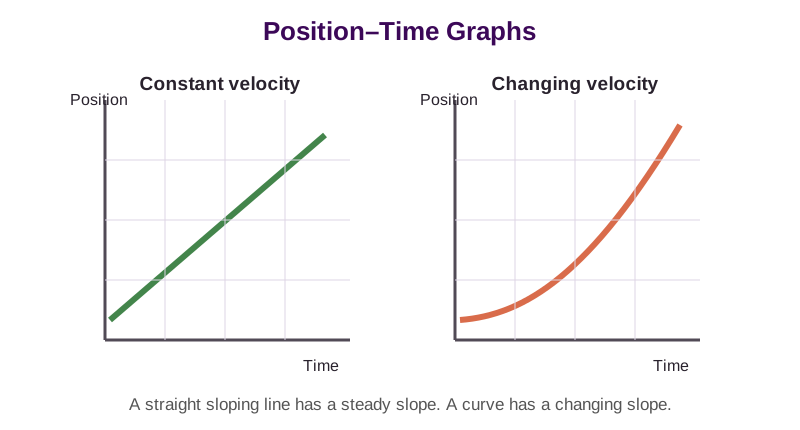
When an object moves in one direction from the starting point, its position and distance travelled have the same value. In that special case, a position–time graph is also a distance–time graph.
6.2 Velocity–Time Graphs
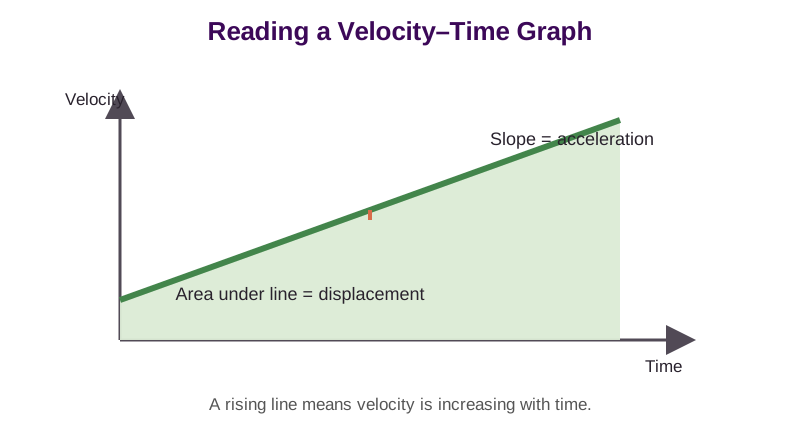
A velocity–time graph shows an object's velocity at different times. A horizontal line shows constant velocity. A sloping line shows that velocity is changing.
The slope of a straight velocity–time graph gives the acceleration. The area between the graph line and the time axis gives the displacement over that time interval.
If the object keeps moving in one direction, the size of its displacement is equal to the distance it travels. In that case, the area also gives the distance travelled.
7. Kinematic Equations
7.1 Motion with Constant Acceleration
Kinematic equations are equations that describe how an object's motion changes with time. These equations help us find a missing value when we know the other values.
For motion in a straight line with constant acceleration, we use:
- Final velocity: v = u + at
- Displacement: s = ut + ½at²
- Velocity and displacement: v² = u² + 2as
In these equations, u is the initial velocity, v is the final velocity, a is the acceleration, t is the time interval, and s is the displacement.
Use matching units in each equation. SI units are m, s, m/s and m/s². CGS units are cm, s, cm/s and cm/s².
These equations work only when acceleration stays constant. Use the signs of velocity, acceleration and displacement to show their directions.
8. Motion in a Plane and in Space
8.1 Motion in a Plane
Motion in a plane takes place in two dimensions. An object can move in two directions, such as forward and sideways. A ball kicked into the air follows a path through a plane.
For motion in a plane, we may need to describe position and velocity in both directions. Motion in a straight line is simpler because we need to describe motion along only one direction at a time.
8.2 Uniform Circular Motion
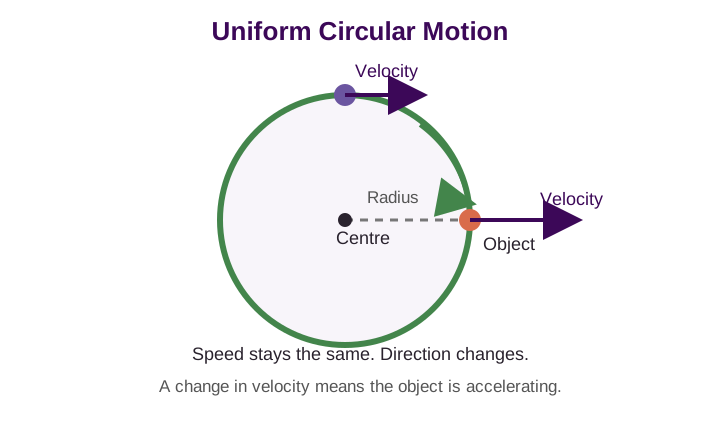
A child on a merry-go-round is one example. The child's speed can stay the same. But the direction of movement keeps changing.
For one full round, let R be the radius of the circle and T the time taken. The average speed is vavg = 2πR ÷ T. Its SI unit is m/s. Its CGS unit is cm/s.
Velocity includes direction. So, a change in direction means a change in velocity. This means an object in uniform circular motion is accelerating, even when its speed stays constant.
After one full round, the object returns to its starting point. Its displacement for the full round is zero. Its distance is the length of the circle's path.
8.3 Motion in Space
Motion in space takes place in three dimensions. An object can move forward or backward, sideways, and up or down. A bird flying through the sky and a car moving up a winding hill are examples.
Three-dimensional motion can be more difficult to describe. We often study simpler motion first, such as motion along a straight line or around a circle.
9. Chapter Summary
- Motion and rest describe whether an object's position changes compared with a chosen reference point.
- Position tells where an object is. We describe it using a distance and, when needed, a direction. An instant is one clock reading; a time interval is the duration between two instants.
- Linear motion follows a straight line. Motion in a plane uses two dimensions. Motion in space uses three dimensions.
- Distance is the full path travelled. Displacement is the straight-line change from the starting position to the ending position.
- Scalars have size only. Vectors have size and direction. The size of a quantity is its magnitude.
- Speed and velocity describe motion in related ways. Speed uses distance; velocity uses displacement and direction. Average and instantaneous values describe motion over a time interval and at one instant.
- Relative speed and velocity describe motion compared with another moving object.
- Acceleration is the rate of change of velocity. Retardation acts opposite to motion and reduces speed.
- Position–time graphs show position over time. Velocity–time graph slope gives acceleration, and area under the graph gives displacement.
- Kinematic equations describe straight-line motion with constant acceleration.
- Uniform circular motion has constant speed, but its changing direction means its velocity changes and it has acceleration.